Posted February 20, 2026
Posted February 20, 2026
Posted January 09, 2026
Written by Nicholas Hellmuth
We focus on flora and fauna associated with national parks of today and plants and animals in the ceramics and stone sculptures of the Classic Maya. So for insects we are studying giant beetles that are in Tepeu 1 polychrome bowls and plates, plus large beetles that are edible, plus lightning bugs (firefly) that are featured in Maya myths of the sacred Popol Vuh.
We continue research on bats in Maya art together with chiropterologist Jose Octavio Cajas.
For plants we are continuing our long-range research concept of Palm Paradise Peten, especially palms with edible parts that don’t require destructive slash-and-burn milpa agriculture.
For archaeology we focus in iconography, epigraphy, cosmology of scenes in Classic Maya art, especially scenes with plants and animals.
You can see our past, present, and future research on:



Our goal is to make documentation available to students (especially for their thesis or PhD dissertation), to scholars (for their classroom lectures, symposia and conference presentations, and for their publications) and for the interested general public so they have reliable documented information on Mesoamerica.
For social media posts, you can find the work of director Vivian Hurtado on FLAAR-Mesoamerica.org and social media sites.
Posted December 24, 2025
Written by Nicholas Hellmuth

This is "Santa Nicholas" being pulled by native deer of Guatemala. The same species of deer that are common throughout the USA are also native and wild even in the rain forests of Guatemala. In Classic Maya art deer are often associated with monkeys—some Maya portraits of deer feature an obvious monkey tail on the deer. And paintings of monkeys often show them with deer antlers and deer ears.
The circular path is the Maya Sky Band with celestial motifs. We have published many PDFs on this topic. Just Google Sky Band Hellmuth FLAAR.
Often the Sky Band is the body of a Bicephalic Cosmic Monster, with "starry-eyed" deer at the left and an upside-down Quadripartite Badge Headdress monster at the right. Just Google Bicephalic Cosmic Monster, crocodile lecture, Hellmuth and you will see lots of Maya art with this cosmic monster.
For year 2026 we will continue with new iconography reports on deer, on monkeys, on bats, on rabbits, on macaws and fish and other native fauna featured in Maya art at the national museum of art and ethnology of Guatemala. The goal is to prepare educational material for the literally hundreds of school groups that visit the museum every month plus the thousands of tourists who also visit this prestigious national museum.
Simultaneously, we will be engaged in field trips and library research on flora, fauna and biodiverse ecosystems of the Reserva de la Biosfera Maya, RBM, Peten, especially of Parque Nacional Yaxha, Nakum and Naranjo (PNYNN) and surroundings.
We now have a new Mavic 4 Pro drone whose aerial camera is significantly better than all previous models that we had in recent years. Most importantly for working in national parks, the Mavic 4 Pro can be flown at eye-level through the forest—so we can show eye-level views in addition to the obviously important aerial views from above.
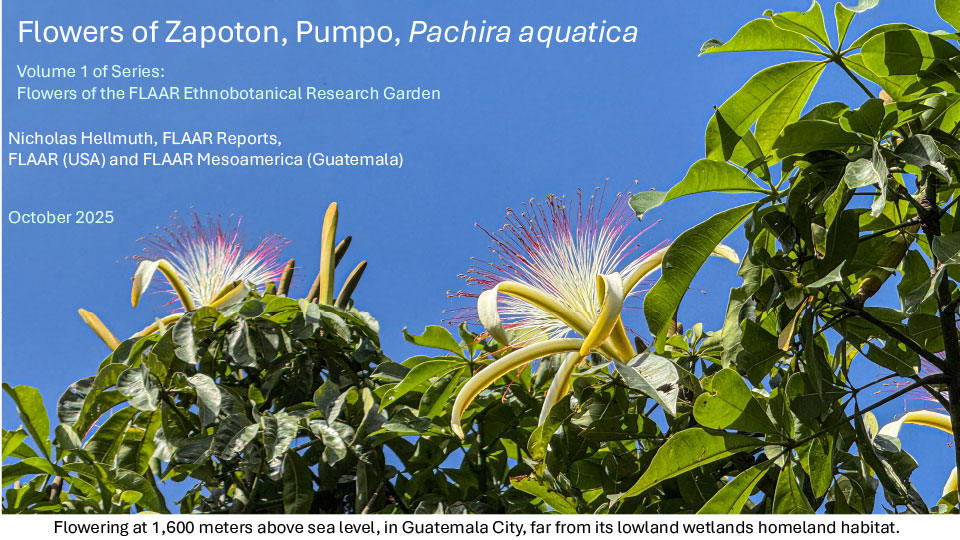
We also continue our long-range research project on all the hundreds of wild plants, native to Guatemala, have edible parts. With the help of the Q’eqchi’ Maya team that work with us, we are preparing FLAAR Reports on several wild plants of the cloud forests of Alta Verapaz that produce edible food without needing slash-and-burn milpa agriculture.
Posted October 21, 2025
|
Posted January 6, 2025
by Nicholas Hellmuth
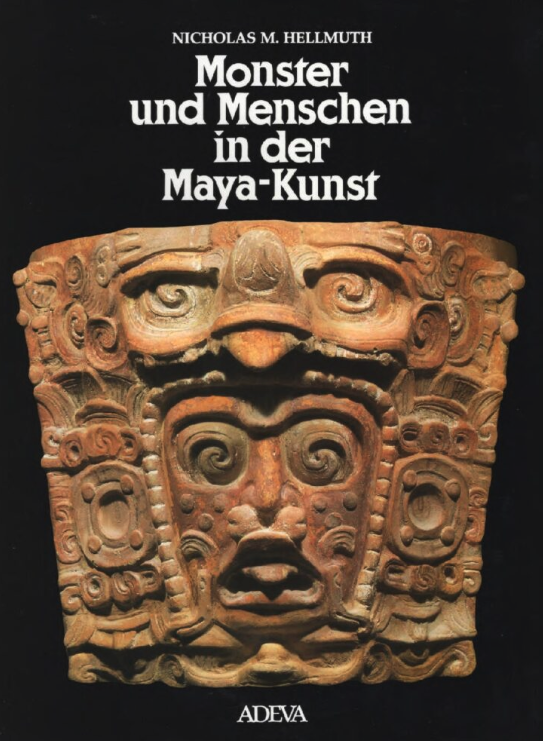
Senaida Ba of the document scanning team of FLAAR Mesoamerica has dedicated many days to scan the entire published edition of Nicholas Hellmuth’s PhD dissertation to make this available to students, scholars, and the general public who are interested in Maya art, iconography, pantheon and archaeology.
Even though the text is auf Deutsch, the captions for the illustrations are also in English. Many of the photographs of Maya art are in color in this German edition. All captions to all 727 photos and line drawings are both in German and in English. Foreword by Michael D. Coe is in English. Discussion of Maya Archaeology, list and definitions of Maya deities in English. Footnotes and Summary are in English.
Published by the Akademische Druck- und Verlagsanstalt, Graz, Austria. Hellmuth got his PhD from the Karl-Franzens Universitaet, Graz, Austria in 1986.
|
Monster und Menschen in der Maya-Kunst, 727 drawings and photos in book of 403 pages. |
Surface of the Underwaterworld, 1987 publication of English edition of Hellmuth’s PhD dissertation, Vol. I, text. |
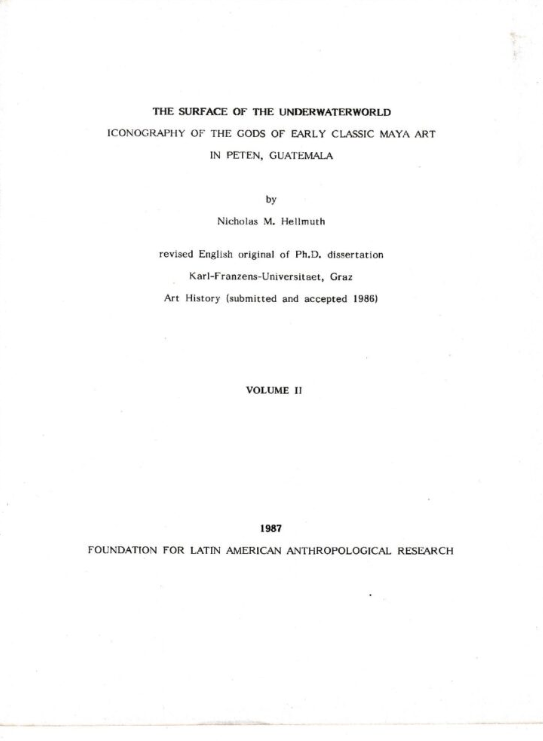
Surface of the Underwaterworld, 1987 publication of English edition of Hellmuth’s PhD dissertation, Vol. II, illustrations. |
Posted November 13, 2024
by Nicholas Hellmuth
We have not posted new material on this site because we have been posting on www.Maya-archaeology.org. Plus we have been working day and night on new FLAAR Reports. But today, in November, we are posting six new reports on Sky Bands. This is work of many months since the Iconography of Cosmology post of January 19, 2024.
|
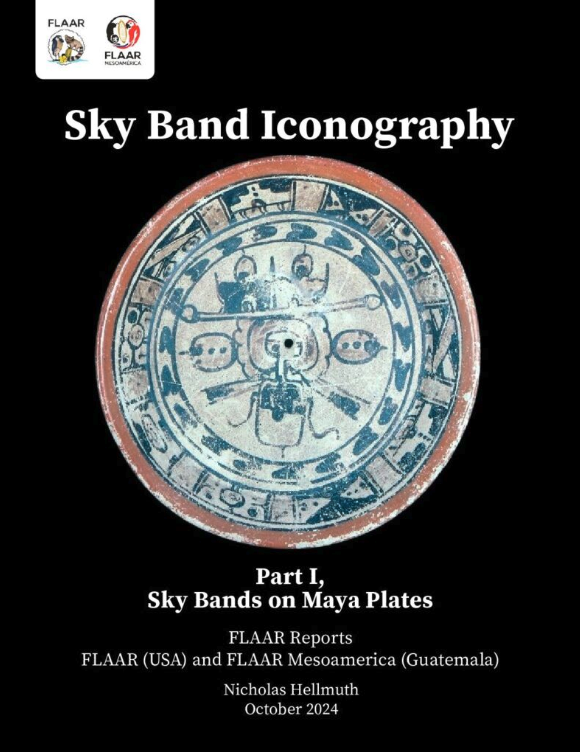
Part I: Sky Bands on Plates of Classic Maya of Peten |
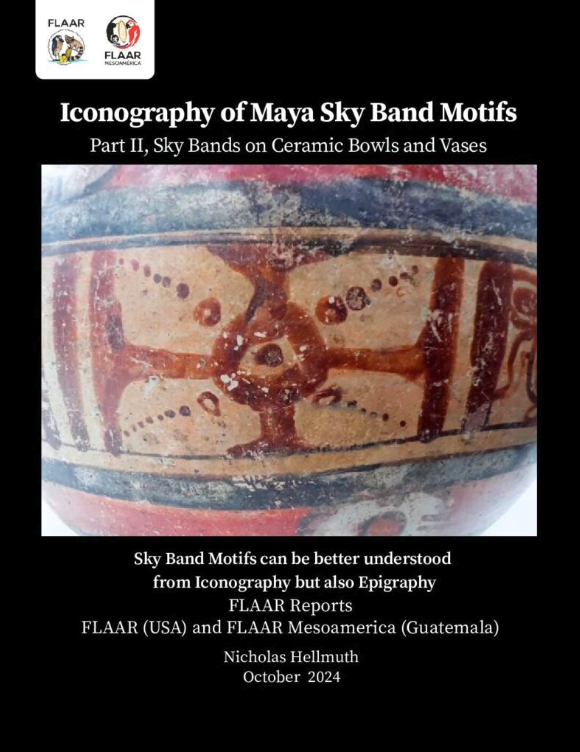
Part II: Sky Bands on Classic Maya Vases and Bowls |
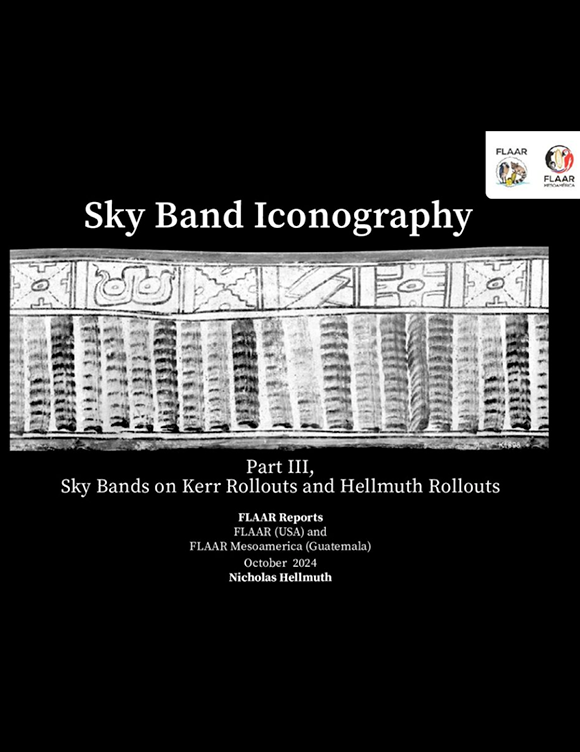
Part II: Sky Bands on Kerr and Hellmuth Rollouts of Vases |
|
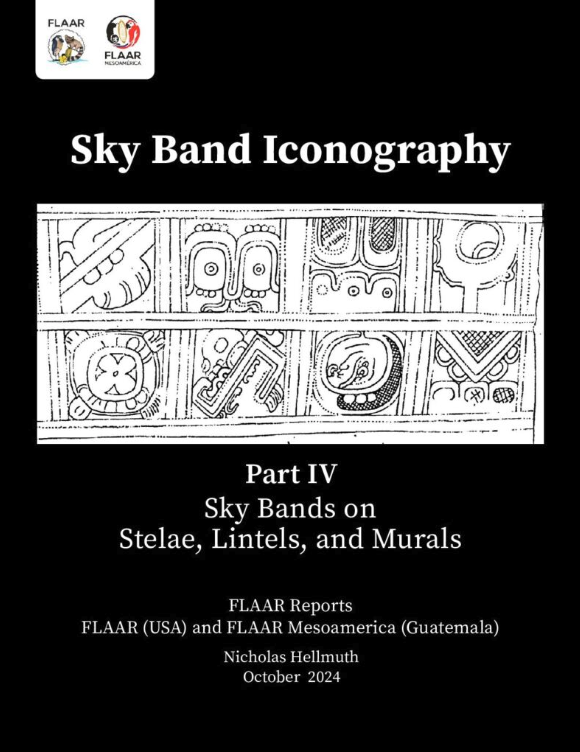
Part IV: Sky Bands on Stelae, lintels and other sculptures of Mexico, Guatemala, Belize |
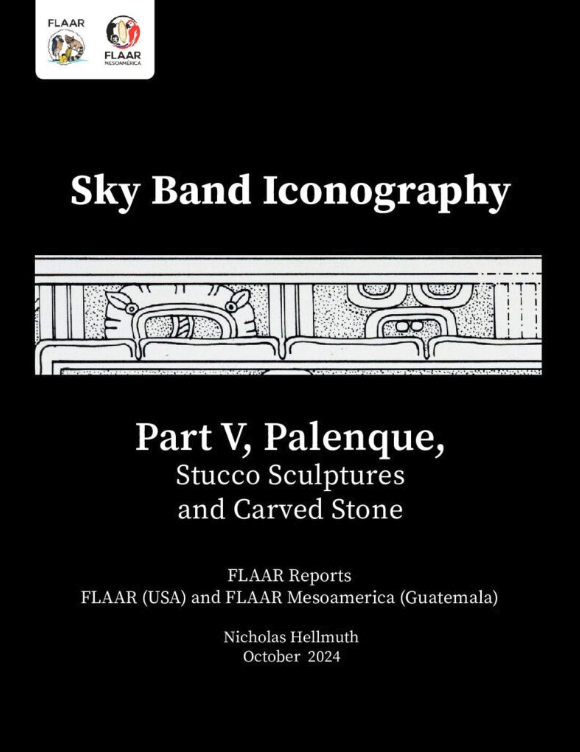
Part V: Sky Bands of Late Classic Maya on stucco reliefs and sculptures at Palenque |
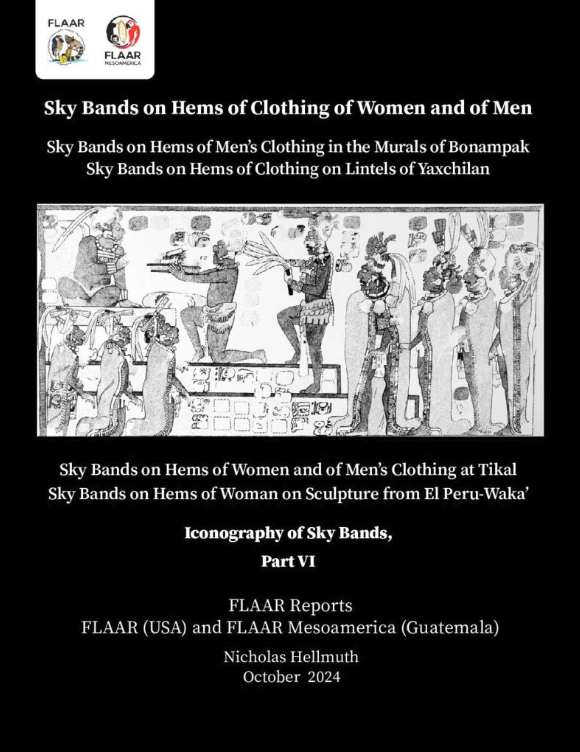
Part VI: Sky Bands on woven textile hems of Maya clothing at Palenque, Tikal, Yaxchilan |
Posted January 19, 2024
This PowerPoint presentation will show scenes not available elsewhere. If you are a student you will find topics for your BA thesis, MA thesis or your PhD dissertation.
If you are a professor this PPTx provides you digital rollouts by Nicholas Hellmuth that have never previously been published. You have permission to download any and all images from this lecture and add to your own presentations.
For the general public this full-color lecture will introduce you to aspects of Classic Maya art (including derived from Olmec art) and continuing into the Post Classic Dresden Codex.
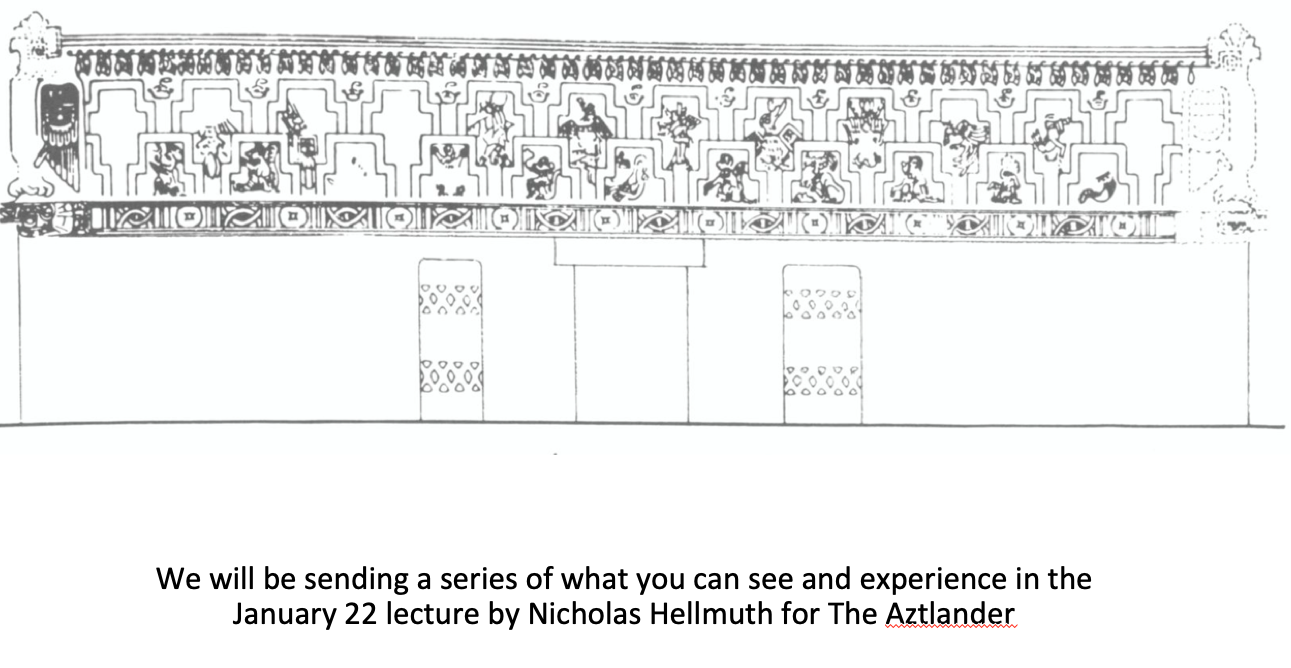
So on the evening of January 22, join us for several thousand years of art, iconography, architecture plus epigraphy of hieroglyphs.
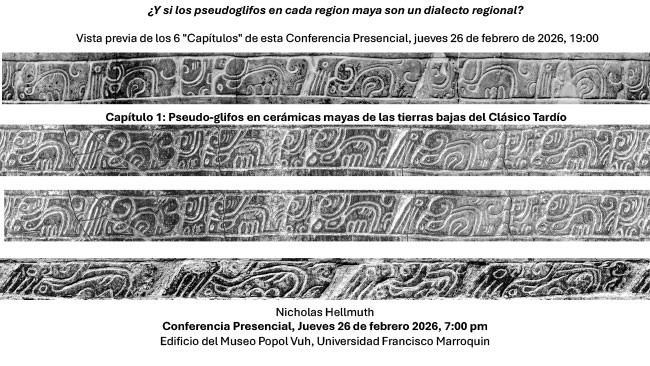
The attached document shows sample illustrations from the lecture.